
If you have searched for a rotary hoe in the last month, you have probably landed on two completely different machines. One is a petrol unit at the hardware store that you push around a garden bed on a Saturday. The other is a hydraulic attachment that bolts onto a five tonne excavator and works a paddock all week. Same two words. Very different jobs.
Then there is the naming. Half the listings say rotary hoe. The other half say rotary tiller, and search throws in rotovator, cultivator and rototiller for good measure. It is enough to make you wonder whether you are comparing the right things at all.
This guide sorts it out. We design and build rotary hoe attachments in our north Brisbane workshop, so here is what the terminology actually means in Australia, where the garden machines and the commercial machines part ways, and how to work out which one your job needs.
Rotary Hoe vs Rotary Tiller: Is There Actually a Difference?
In Australia, no. A rotary hoe and a rotary tiller are the same machine. The two names describe a powered rotor fitted with curved tines that spins into the soil, cuts it, breaks up clods and leaves a worked surface behind.
Which word you use mostly depends on where you learned it. “Rotary hoe” is the common Australian term and it is what most operators here type into Google. “Rotary tiller” turns up more often in manufacturer catalogues and imported product listings. Neither one describes a different mechanism.
Where the Confusion Comes From
The mix-up starts overseas. In North American agriculture, a rotary hoe is a genuinely separate implement: a ground-driven tool running rows of spoked wheels, used at speed to break surface crust and knock over tiny weeds before a crop gets established. It has no engine or hydraulic motor driving the working parts at all.
So when an Australian buyer reads an American article comparing a “rotary hoe” to a “rotary tiller”, they are reading about two different implements. Locally, the two words point at the same thing. Once you know that, most of the contradictory advice online starts to make sense.
What Every Rotary Hoe Does, Whatever You Call It
Strip the branding away and the job is consistent:
- Cuts and lifts soil to a set working depth
- Breaks compacted clods down to a workable tilth
- Mixes in organic matter, lime, gypsum or the remains of old turf
- Leaves a level surface ready for seed, turf or planting
Everything else on the spec sheet is about scale and how the machine gets its power.
Two Machines, One Name: Walk-Behind vs Carrier-Mounted Rotary Hoes
This is the split that actually matters, and it is the one the search results blur.
Walk-Behind Rotary Hoes
A walk-behind rotary hoe carries its own petrol or electric engine, sits on a set of small wheels and is steered by an operator on foot. Consumer models run cutting widths of around 500mm. Hardware stores sell them and equipment hire yards rent them by the day, which is why “rotary hoe hire” is one of the most searched terms in this category.
They do a good job on soft, previously worked soil. A vegie patch, a small front lawn, a garden bed you want to turn over before planting. What they are not built for is compacted ground, big areas or day after day of work. The operator absorbs every bit of vibration and kickback the machine produces, and an hour of that on hard ground is genuinely tiring.
Carrier-Mounted Rotary Hoes
A carrier-mounted rotary hoe has no engine of its own. It draws power from the machine it is attached to, either the hydraulic system on an excavator or skid steer, or the PTO on a tractor. The operator sits in the cab.
That changes the economics of the job. You get more working width, more torque into hard ground, and the ability to keep going for as long as the carrier has fuel. This is the category commercial landscapers, turf contractors, civil operators and growers are buying in.
| Walk-behind rotary hoe | Carrier-mounted rotary hoe | |
| Power source | Own petrol or electric engine | Carrier hydraulics or tractor PTO |
| Operator position | On foot, behind the machine | In the cab |
| Typical work | Garden beds, small lawns, one-off jobs | Paddocks, building pads, turf and landscaping contracts |
| Ground covered | Small areas, slow going | Large areas, single pass |
| Physical effort | High. The operator wears the vibration | Low. The carrier does the work |
| How people get one | Buy outright or hire by the day | Attachment added to a machine you already run |
| Best fit | Hobby and home use | Commercial and repeat work |
Hobby or Commercial Duty: Which Rotary Hoe Fits Your Work
Be honest about what you actually do. Plenty of people buy too much machine, and plenty more spend three weekends fighting a hire unit that was never going to cope.
A walk-behind rotary hoe is the right call if:
- You are working garden beds or a lawn under a few hundred square metres
- The soil has been worked before and is not badly compacted
- You use it a handful of times a year
- You do not already own an excavator, skid steer or tractor
A carrier-mounted rotary hoe is the right call if:
- You are preparing ground for turf, seed or planting as part of your work
- You already run an excavator or skid steer and want it earning on more jobs
- The ground is compacted, or it is virgin ground that has never been worked
- Finish quality matters because a client is paying for it
- You need the same job done again next week on a different site
That last point is the one that usually settles it. Day rates on hire equipment add up fast, and once ground preparation becomes a regular line item rather than an occasional task, an attachment on a machine you already own is the cheaper way to do the work.
Carrier Compatibility and Hydraulic Flow Rates
If you are shopping for an attachment, the number that decides whether it will work on your machine is hydraulic flow, measured in litres per minute.
Our EZ-140-RH runs off standard and high flow hydraulics and fits both excavators and skid steer units. The minimum flow rate required is 55lpm and the maximum relief pressure is 240Bar. Match those two figures against your carrier’s auxiliary hydraulic specs and you have your answer.
Why Flow Rate Matters More Than Machine Weight
Operators tend to size attachments by tonnage out of habit. With a hydraulically driven rotor, flow is what turns it, and pressure is what keeps it turning when the tines load up in hard ground.
Under-supply the flow and the rotor slows under load, the finish goes patchy and you end up doing a second pass. Over-supply it without the right relief pressure setting and you put unnecessary heat and strain through the motor. It is worth pulling the auxiliary hydraulic figures off your machine before you shortlist anything.

Fitting a Rotary Hoe to a Tractor
If your prime mover is a tractor, you are looking at a PTO-driven tractor rotary hoe running off a three-point linkage rather than a hydraulic attachment. Different mount, same principle. Our rotary hoe is built for hydraulic carriers, which is where most landscaping, turf and civil operators sit. Give the team a call if you want to talk through a tractor setup and we will tell you straight whether we are the right fit.
The Offset Design Advantage: No Wheel Tracks Left Behind
Here’s the detail most product listings skip. On the EZ-140-RH, the rotor sits offset to one side of the carrier rather than directly in line with the wheels or tracks. You work a strip of ground the machine itself never drives across.
The practical result is a clean finished surface with no tracks pressed back through it, and no second pass to tidy up what the carrier just compacted. On a turf job or a seedbed, that is the difference between handing over a finished site and going back over your own work.
The agronomy behind it is well documented in Australia. GRDC’s controlled traffic calculator shows a typical unmatched machinery system drives over roughly 48.6% of the paddock, while a well-matched controlled traffic system cuts that to about 13.2%. Research summarised in the Soil Quality Knowledge Base puts uncontrolled traffic at around 45 per cent of the paddock in a single season, accumulating to the entire paddock over a few seasons. Compacted soil holds less water, drains worse and makes root penetration harder.
You are not going to run a full controlled traffic system off one attachment. But keeping the carrier off the ground you have just prepared is the same idea applied at job scale, and it shows in the finish.
What a Rotary Hoe Is Good For, and Where Another Machine Wins
A rotary hoe earns its keep on:
- Seedbed preparation before planting or sowing
- Incorporating lime, gypsum, compost or fertiliser through the top layer of soil
- Breaking up old turf and thatch before a fresh lay
- Levelling and conditioning building pads ahead of landscaping
- Preparing horticultural rows and market garden beds
- Turning in weeds and crop residue
It is the wrong machine for a few jobs, and we would rather say so:
- Deep compaction below the working depth is a job for a soil aerator or a ripper, not a rotary hoe
- Stumps and heavy root balls need a stump grinder
- Standing scrub and regrowth need a mulcher
- Ground with rock close to the surface will chew through tines quickly no matter whose machine you run
Matching the machine to the ground in front of you saves far more money than shaving a few hundred dollars off the purchase price.
Buying a Rotary Hoe in Australia: What to Check First
Once you start looking at a rotary hoe for sale, work through this list before you compare prices:
- Flow and pressure match. Confirm the minimum flow rate and maximum relief pressure against your carrier’s auxiliary hydraulics
- Working depth. Know how far into the ground the machine will actually engage, and whether that suits the job
- Tine design. Reversible tines can be flipped when one edge wears, which halves your consumables bill over the life of the machine
- Mount type. Excavator, skid steer or tractor PTO. Getting this wrong is an expensive mistake
- Parts and support. Imported machines can leave you waiting weeks on a part. Ask where the parts are held before you buy
- Custom capability. If your setup is unusual, ask whether the manufacturer can modify the machine rather than telling you to make do
Finance is worth asking about too. Spreading the cost of an attachment over its working life often makes more sense than paying hire rates on a job you now do every month.
The EZ-140-RH Rotary Hoe, Built in Brisbane
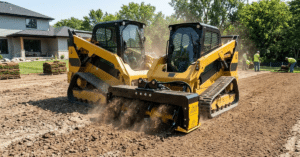

The EZ-140-RH is our rotary hoe attachment for ground preparation prior to planting. It engages up to 110mm underground, runs reversible tines to keep operating costs down, and fits both excavators and skid steers on standard or high flow hydraulics.
The offset design leaves no wheel tracks behind, which is why it suits landscaping, lawn preparation and specialised ground preparation work where the finished surface is the deliverable. It is designed and built in our facility at Deception Bay, north of Brisbane, and shipped Australia-wide.
You can see the full EZ-140-RH specifications or browse the wider rotary hoe attachment range to compare it against the rest of our excavator and skid steer gear.
If the standard machine is not quite right for your carrier or your ground, our in-house team will modify it or build one that is. A lot of our custom jobs end up becoming standard options.
Frequently Asked Questions
What is the difference between a rotary hoe and a rotary tiller?
In Australia there is no mechanical difference. A rotary hoe and a rotary tiller are the same machine, and the two names are used interchangeably. The confusion comes from North America, where “rotary hoe” refers to a separate ground-driven implement used for crust breaking and early weed control.
What is a rotary hoe good for?
A rotary hoe is used to break up and mix soil before planting. Common jobs include seedbed preparation, incorporating lime, gypsum or compost, breaking up old turf, and conditioning building pads before landscaping. It works the top layer of soil rather than fixing deep compaction.
Is a rotary hoe easy to use?
A walk-behind rotary hoe takes physical effort. The tines can grab and pull the machine forward in hard or stony ground, so you need a firm grip and a steady pace. A carrier-mounted rotary hoe is far easier on the operator because the excavator or skid steer takes the load and the operator works from the cab.
Does Bunnings sell or hire rotary hoes?
Bunnings sells small petrol and electric walk-behind rotary hoes and garden cultivators. For hire, most people go through a dedicated equipment hire yard, where a walk-behind rotary hoe is a standard item on the daily hire list. Neither option covers commercial-duty ground preparation, which is where carrier-mounted attachments come in.
How deep does a rotary hoe go?
It depends on the machine. Consumer walk-behind units work the top layer of loose soil. Our EZ-140-RH engages up to 110mm underground, which suits seedbed and turf preparation. For deeper compaction you need a soil aerator or a ripper instead.
What hydraulic flow do I need to run a rotary hoe attachment?
Check the manufacturer’s minimum flow rate against your carrier’s auxiliary hydraulics. The EZ-140-RH requires a minimum flow rate of 55lpm and a maximum relief pressure of 240Bar, and runs on both standard and high flow systems.
Can you put a rotary hoe on a skid steer?
Yes. Hydraulic rotary hoe attachments are made for both skid steers and excavators. The EZ-140-RH fits either, provided the carrier meets the flow rate and relief pressure requirements.
Do I need a tractor to run a rotary hoe?
No. A tractor rotary hoe runs off a three-point linkage and PTO, but hydraulic models mount to excavators and skid steers instead. Which one suits you comes down to the machine you already own.
Should I buy or hire a rotary hoe?
Hire suits a one-off job on a small area. If ground preparation is part of your regular work and you already run an excavator or skid steer, buying an attachment usually costs less over a season than repeat hire, and the machine is on site when you need it.
Are EZ Machinery rotary hoes Australian-made?
Yes. Every machine is designed and built at our facility in Deception Bay, north of Brisbane, and shipped Australia-wide. We build to Australian Standards and hold parts on home soil.
Talk to EZ Machinery About the Right Rotary Hoe for Your Machine
Still weighing up a rotary hoe vs rotary tiller, or trying to work out whether an attachment will run on your carrier? Send us the make and model of your excavator or skid steer along with its auxiliary hydraulic figures and we will tell you straight whether the EZ-140-RH is a match.
Request a quote or get in touch with the team to talk it through. You can also reach us on 1300 736 982, Monday to Friday.
EZ Machinery designs and builds the EZ-140-RH rotary hoe, soil aerators and the full range of excavator and skid steer attachments from our north Brisbane facility. Have a look at the range or give the team a call on 1300 736 982 to talk through which model suits your machine and the work in front of you.


